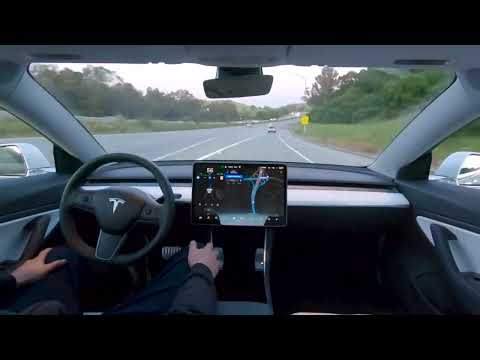
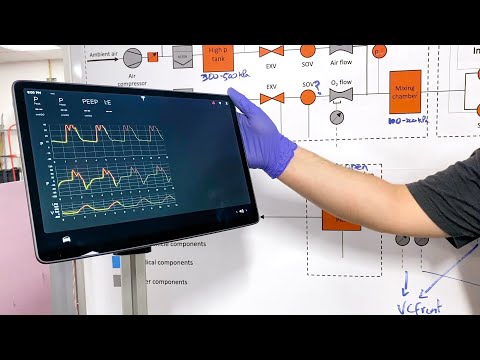
Tesla Model 3 and Y Modular Motors
Pourquoi cette vidéo a été sélectionnée
Partagée sur Hacker News (6 points). Points forts estimés : contenu durable.
Recommandations à l'origine de la sélection
- Hacker News : « The Tesla Model 3's Modular Motors » — 6 points, 2021
Description de l'auteur — Afficher plusAfficher moins
Check out the modular components and design of the electric motors on the Tesla Model 3 and Model Y. See how many parts are common and interchangeable. Corrections: 1. I swapped the definition of a Hunting gear set with a Non-Hunting gear set. TIMELINE: 0:00 Introduction 0:27 The rear motor of the Model 3 and Y 1:08 The input shaft with 31 teeth (Prime Number) 2:00 the input shaft SKF bearings for a rotor speed of 18,447 at 262 km/h (163 mph) 2:40 The countershaft and gear with 81 teeth (Factors 3, 3, 3, 3) 3:00 The input shaft to the countershaft gear ratio of 81/31 = 2.6129:1 3:10 The countershaft pinion gear with 24 teeth (Factors 2, 2, 2, 3) 3:15 The ring gear and differential case with 83 teeth (Prime Number) 4:30 The countershaft to ring gear ratio of 83/24 = 3.4583:1 4:43 The overall gear ratio = (81/31) x (83/24) = 9.0363:1 5:03 The published gear ratio is incorrect. This is a Hunting Gearset 5:48 The CV half-shafts connect to the differential side gears 6:46 MUST SEE: two cool Permanent Magnet rotor demonstrations 8:05 The modular design of the motor shafts and rotors 8:25 MUST SEE: Watch as a rear motor is changed into a front motor 10:32 The differences in the modular motors 11:35 See what a permanent magnet does to the Induction Rotor 11:55 An aluminum core front induction rotor on the Model Y 12:13 There are at least three different rotors for the Models 3 and Y 13:54 See the rear motor inverter and where it attaches to the rear housing 14:45 The matching part numbers of the rear inverter and the stator (A matched set) 15:15 The three different power and torque levels of the Model 3 and Model Y 16:15 MUST SEE: See the front motor inverter attached to the rear housing! 17:37 the common bolt pattern and opening for the stator housings 18:30 The oil-cooled stator and ATF-9 fluid 18:47 The interchangeable transmission heat exchanger 19:13 The interchangeable variable-speed electric oil pump 20:25 The interchangeable spin-on oil filter 21:06 What is not interchangeable between models 21:20 The rear drive unit is mounted parallel with the ground 22:20 The front drive unit is mounted upside down and at an angle 23:05 The matching part numbers of the front inverter and the stator (A matched set) 26:30 Additional EV training opportunities at https://www.weber.edu/evtraining 26:58 Video summary and donation opportunity I have nothing to prove this, but while looking at used Model 3 motors for sale on eBay, I gathered the following information. There are three different part numbers for the combined rear motor inverters and stators. Stators can have different milli-ohm resistance values and still appear identical. * 1120970-00-D (24 SiC IGBT modules Based RWD model 3) * 1120980-00-C, D, F (24 SiC MOSFET modules Performance AWD model 3) * 1120990-00-F (18 SiC MOSFET modules Non-Performance AWD model 3) ABOUT US Weber State University (WSU) Davis Campus - Automotive Technology Department - Advanced Vehicles Lab. A technical description and operational demonstration of the Tesla Model S Rear Drive Unit (RDU) and Front Drive Unit (FDU). We teach current vehicle technologies to our automotive students at Weber State University and online. For more information, visit: http://www.weber.edu/automotive This video was created and edited by Professor John D. Kelly at WSU. For a full biography, see http://www.weber.edu/automotive/J_Kelly.html Visit my other YouTube channel https://www.youtube.com/user/vibratesoftware to see the amazing NVH app for vibration diagnosis! ADDITIONAL TRAINING FOR YOU Join us for hybrid and electric vehicle training with two online courses and a 5-day on-campus boot camp with Professor John D. Kelly. See http://www.weber.edu/evtraining DONATE TO OUR DEPARTMENT Please consider a donation to the Department of Automotive Technology at Weber State University here: http://advancement.weber.edu/Automotive
Détail de la note
| Pertinence thématique | 96 | Pertinence thématique estimée à 96 % (univers principal : automobile) |
| Profondeur technique | 39 | Profondeur technique estimée à 39 % d'après le titre, la description et la durée |
| Qualité pédagogique | 31 | Valeur pédagogique estimée à 31 % |
| Intérêt historique | non mesurable | Pas de dimension historique détectée (non mesurable) |
| Originalité | non mesurable | Non mesurable sans analyse par modèle de langage |
| Crédibilité de l'auteur | non mesurable | Crédibilité de la chaîne non évaluée |
| Recommandations indépendantes | 41 | 1 recommandeur distinct ; soumission votée 6 fois |
| Recommandations dans la durée | 15 | Recommandée sur 1 mois distinct, 1 année différente |
| Valeur durable | 80 | Contenu durable |
| Rareté | 50 | 891 104 vues sur YouTube |
| Fraîcheur | non mesurable | Sans objet pour un contenu durable |
Confiance 75 % · score-v1 · heuristic-2026.11.1 · méthode