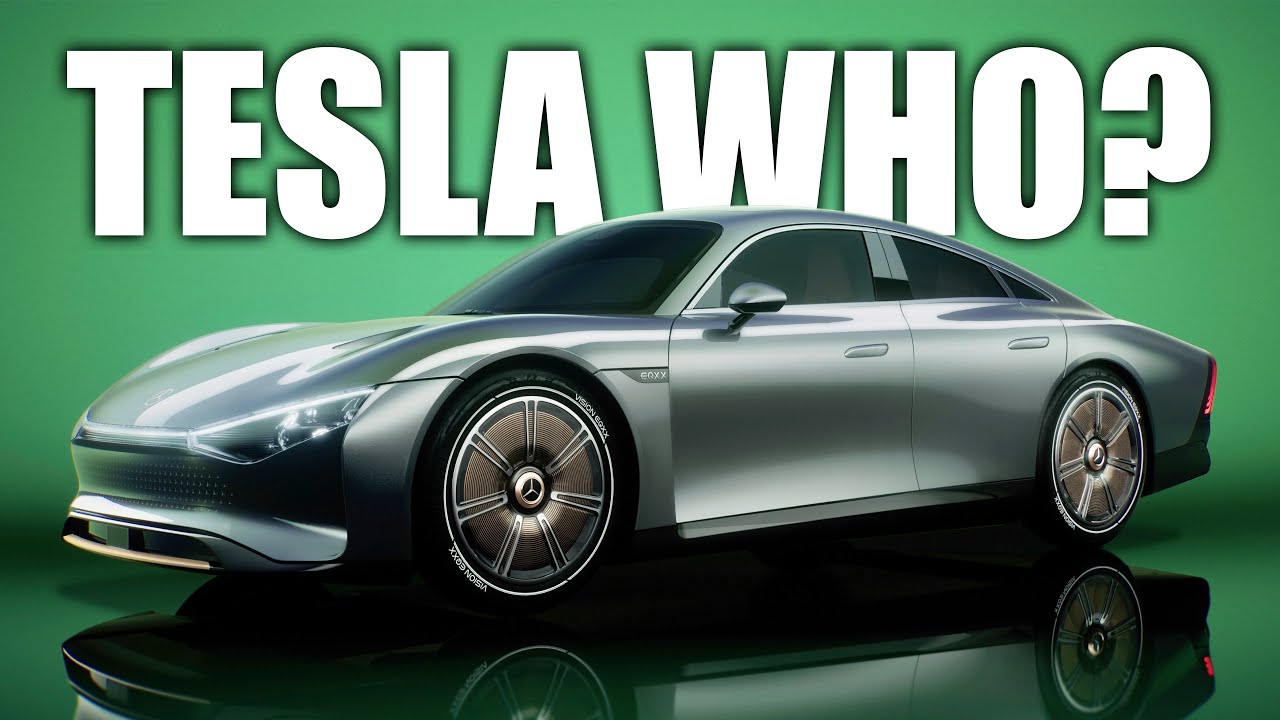
The Most Efficient Car Ever Created? Mercedes EQXX
Pourquoi cette vidéo a été sélectionnée
Partagée sur Hacker News (8 points, 7 commentaires). Points forts estimés : profondeur technique, contenu durable.
Recommandations à l'origine de la sélection
- Hacker News : « The Most Efficient Car Ever Created? Mercedes EQXX [video] » — 8 points, 7 commentaires, 2023
Description de l'auteur — Afficher plusAfficher moins
What is the limit on efficiency for cars? How low can energy consumption go?! Subscribe to Engineering Explained for more videos! - https://goo.gl/VZstk7 Recommended Books & Car Products - http://amzn.to/2BrekJm EE Shirts! - http://bit.ly/2BHsiuo The Mercedes EQXX is the most efficient car Mercedes has ever created, and set out to achieve 1,000 kilometers on a single charge of a 100 kWh battery, with a goal of the elusive 10kWh/100km energy consumption benchmark. They did this by optimizing everything about the car for efficiency: aerodynamics, weight, rolling resistance, and powertrain efficiency. It even has some solar panels for a little extra juice! Were they able to achieve nearly double the range of today's EVs? Mercedes EQXX Assumptions For the energy consumption vs speed plot (flat ground, constant speed) an assumption is made for the electrical consumption of the vehicle at 250W. This value was chosen because Mercedes claims the solar setup on the EQXX is capable of generating (rough average) 25 km of range in a day. With an efficiency of 8.3kWh/100km, and knowing we get 25 km of range in a day from solar, we can divide 8.3kWh by 4 (25km = 1/4 of 100km) giving us a daily production of around 2 kWh from the solar system. Let’s assume 8 hours of good daylight, so 2kWh/8hr = 250W. Mercedes also told me there were times the solar output exceeded the overall system energy required, meaning at times the system was operating under (the assumed) 250W solar output. References: Highest EV MPG - https://www.fueleconomy.gov/feg/topten.jsp?year=all&action=AllYears Highest ICE MPG - https://www.fueleconomy.gov/feg/topten.jsp?year=all&action=ExEvsPhevs Tesla Model S Stats - https://dis.epa.gov/otaqpub/display_file.jsp?docid=54291&flag=1 EQXX Tire Crr - https://media.mbusa.com/releases/mercedes-benz-vision-eqxx-demonstrates-its-world-beating-efficiency-in-real-world-driving-over-1000-km-on-one-battery-charge-and-average-consumption-of-87-kwh100-km 1200 km EQXX - https://media.mercedes-benz.com/article/7ff22683-8864-43a7-a26a-e89107251055 Frontal Area Estimates - https://www.tesla.com/sites/default/files/blog_attachments/the-slipperiest-car-on-the-road.pdf Vehicle Efficiency Video - https://youtu.be/WXiiB7yzxGA Energy Consumption Plot - https://www.researchgate.net/publication/350853224_Numerical_Energy_Analysis_of_In-wheel_Motor_Driven_Autonomous_Electric_Vehicles Engineering Explained is a participant in the Amazon Influencer Program. Don't forget to check out my other pages below! Instagram: http://www.instagram.com/engineeringexplained Facebook: http://www.facebook.com/engineeringexplained Twitter: http://www.twitter.com/jasonfenske13 EE Extra: https://www.youtube.com/channel/UCsrY4q8xGPJQbQ8HPQZn6iA
Détail de la note
| Pertinence thématique | 66 | Pertinence thématique estimée à 66 % (univers principal : automobile) |
| Profondeur technique | 81 | Profondeur technique estimée à 81 % d'après le titre, la description et la durée |
| Qualité pédagogique | 31 | Valeur pédagogique estimée à 31 % |
| Intérêt historique | non mesurable | Pas de dimension historique détectée (non mesurable) |
| Originalité | non mesurable | Non mesurable sans analyse par modèle de langage |
| Crédibilité de l'auteur | non mesurable | Crédibilité de la chaîne non évaluée |
| Recommandations indépendantes | 41 | 1 recommandeur distinct ; soumission votée 8 fois |
| Recommandations dans la durée | 15 | Recommandée sur 1 mois distinct, 1 année différente |
| Valeur durable | 80 | Contenu durable |
| Rareté | 50 | 507 595 vues sur YouTube |
| Fraîcheur | non mesurable | Sans objet pour un contenu durable |
Confiance 61 % · score-v1 · heuristic-2026.11.1 · méthode